

- Dale Ludwig Meetings
This article is about what you can do to make business meetings better. I don’t need to spend much time talking about why meetings need to be improved. A simple Google search will show you that people think there are too many. They are overwhelming. They drain energy. And the coffee-mug meme declaring that this meeting could have been an email.
While the ideas presented here are appropriate for the range of meetings that take place at work, my focus is on the facilitation of internal meetings. This type of meeting, often routine and recurring, is the biggest target for complaints. Because these meetings are so commonplace, the leader of the meeting and its participants often put minimal effort into them. For external meetings, when clients or outside stakeholders are present, the landscape changes. The stakes are higher, and more effort is made to ensure success.
No Amount of Planning Guarantees a Successful Meeting
Back to what’s wrong with meetings. If you expand your Google search to focus on how to improve meetings, most of what you’ll find focuses on planning. Recommendations include thinking carefully about who’s invited to the meeting, sending out an agenda in advance, ending on time, and so on. All good advice. What these articles miss, though, is that planning does not guarantee a successful meeting. Meetings succeed in the moment, when participants are engaged and cooperative, when the conversation that takes place is managed well, and when the meeting feels relevant and efficient.
For these things to happen, the person running the meeting needs the cooperation of participants. And, as anyone who has ever facilitated a meeting knows, that cooperation is not guaranteed. There are as many reasons for this lack of commitment as there are meeting participants. Busy schedules, conflicting commitments, confusion, and resentment can all play a role. Perhaps the most fundamental reason is that many participants are simply not feeling it. They may understand the need for the meeting, but they are not, at this moment in time, willing to exert the energy required.
Making this more difficult is the fact that when participants are not willing to do the work, they hide it. Out of politeness or professionalism, they put up a façade that makes them appear attentive when they are checked out. They may also go into let’s-get-this-over-with mode, staying silent because anything they contribute will extend the meeting. When you’re leading a meeting, your biggest challenge lies in these hidden feelings.
For this reason, it’s time to talk about how people respond emotionally during meetings and how seemingly small things can lead to shutdown. The question I’ll answer is: what can the leader of a meeting do to make people feel like doing the work the meeting requires?
The Role of Emotional Intelligence in Meetings
Let me illustrate this with a story about my first teaching job. This is about what happens when participants in a meeting have no desire to hide their feelings. I was working as a high school English teacher. My students were sophomores, most 15 years old. These students had no filter and no qualms about telling me what they thought of what we were doing. Every day, I heard things like, “This is stupid.” “What’s the point of this?” And the classic, “Is this on the test?” At the time, they frustrated and angered me, but in retrospect, I can see they taught me some important lessons.
While I didn’t have a word for it at the time, those students and I both lacked emotional intelligence (EQ). Here’s a useful definition from Simply Psychology. “Emotional intelligence refers to the ability to perceive, understand, and manage one’s own emotions and relationships. It involves being aware of emotions in oneself and others and using this awareness to guide thinking and behavior.” That was not happening in my classroom.
EQ offers a way to discuss how the process of communication is managed. It’s not so much about getting your message across as it is about how people respond as the message is delivered, how they feel about you, and what you have to say. For the sophomores and me, emotions butted heads every day. Neither of us was willing to take into account how the other was feeling, focusing instead on what we had to say and not on how it was being received.
Because these students did not conceal their feelings (and at 15, who can?), they gave me a clear glimpse into what happens during a lot of meetings. If we were to jump ahead a couple of decades and observe my former students in a business meeting, I’m sure we’d see that they had learned to apply filters. They would be able to sit through a frustrating meeting looking as attentive as can be, while on the inside thinking, “What is the point of this?” or “This is stupid.”
Buy-In Must Be Earned
What those students taught me was that people leading meetings should not assume they have everyone’s buy-in. Buy-in is earned at the start of every meeting and continues to be earned as the meeting takes place. Not doing so leads to all the frustrations people have with meetings: the apathy, the sour attitudes, and the reluctance. The assumption meeting facilitators should make is that, regardless of how people appear, they are not on board.
For meeting facilitators, this requires a good dose of skepticism. A skeptical facilitator assumes their meetings will not go as planned. They assume that meeting attendees won’t fully participate and that many will feel the meeting is a waste of time.
Let’s see how this looks at a meeting. As people arrive, grab their coffee, and take a seat, a skeptic would assume that they are feeling suspicious. They may appear happy enough, but inside, they may feel apathetic, impatient, anxious, or uncertain. These feelings result in reactions like these.
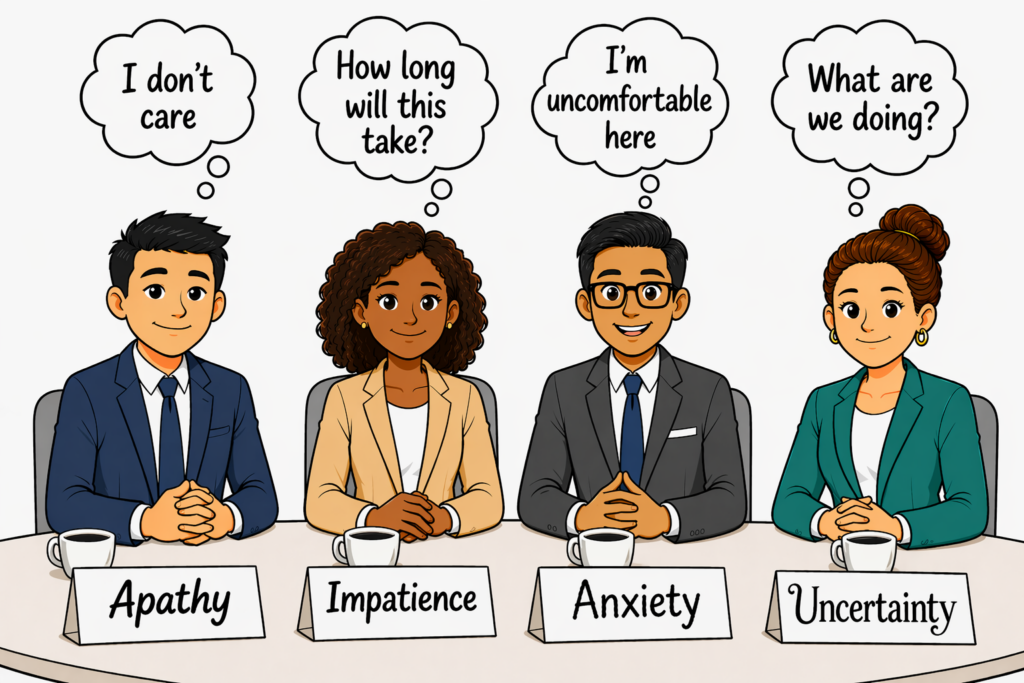
4 Responsibilities of a Meeting Facilitator
The facilitator’s job is to accept these natural responses to meetings and manage them as efficiently as possible. To talk about how that is done, I’ll look at four primary responsibilities facilitators have and how they can help you facilitate a fruitful conversation at your meetings.
- Earn trust and be the person others want to work with
- Make people feel comfortable
- Encourage participation in the conversation
- Control the process to keep the meeting on track
Let’s go into detail with each of them.
1. Earn Trust and Be the Person Others Want to Work With
 “What are we doing?” “Why are we doing it?” “What does this have to do with me?”
When meeting attendees give you their time to attend a meeting, they need to trust you to manage it well. Earning trust happens at the very beginning of the meeting when you answer the questions “What are we doing?” and “Why are we doing it?” We call this the meeting’s frame. The frame formalizes the meeting and focuses on the process that is about to take place. It also emphasizes the relevance of the meeting to attendees.
Delivering the frame also inspires confidence in you as the facilitator because it makes clear that you are making the effort to bring reluctant people into the conversation. You have not assumed that the people seated at the table are ready to get to work. This is the first step in establishing yourself as a person people want to work with.
The frame includes the agenda as well as a current situation statement, a goal statement, and a list of participant benefits. For meetings that address complex issues or involve extensive conversation, it may also include a process statement describing how the interaction will be managed. The frame, because it focuses on what participants are feeling and what they want, builds trust that the meeting will be useful to them.
Framing a Meeting Puts Attendees at Ease
Let’s look at each part of the frame in more detail. These four parts of the frame can be delivered in any order, whatever feels right for your meeting and the people who are there.
Current Situation
The current situation is a statement about why the meeting is happening. It places the meeting in the participants’ context and is almost always something participants are aware of. Often, it begins with an “As you all know…” statement. The Current Situation answers the question, “Why are we doing this?”
The thing to remember is that, whatever the Current Situation is, however obvious it may be, it should be stated briefly. It assures participants that you understand why the meeting is happening and how it fits into their world.
Goal
Stating the meeting’s goal is necessary and too often ignored. When this happens, it’s usually because facilitators assume everyone knows what the goal of a meeting is. While that may be true, stating the goal answers the question “What are we doing?” It doesn’t have to be long or elaborate. In fact, it’s better if it’s short and clear. It’s good to consider what you want people to do, think, or feel at the end of the meeting because it focuses the goal on the participants in the meeting.
A simple, concise statement of the meeting’s purpose (1) gives participants guardrails for the discussion, what topics or conversations don’t belong in this meeting, and (2) indicates what needs to happen for the meeting to end. Both of these offer comfort to participants worried about the focus and length of the meeting.
Agenda
If the goal is a statement of where you’ll be when the meeting is over, the agenda is the outline for how you’ll get there. It provides a sense of order and structure. Also, like the goal, it identifies which topics are appropriate for this meeting and which are not. Don’t go into too much detail with the agenda. Treat it as a list.
Benefits
There can be many types of benefits from your meetings. Benefits are about how people will feel when the meeting is over, feeling good about the way forward or relief that a problem was solved. The benefits statement communicates relevance (“What does this have to do with me?”). If the meeting is made up of people in different roles, there may be different takeaways for each group.
Here’s an example of a frame, bringing together each of the four steps above.
- Current Situation: As you all know, we are facing some disturbing customer service issues.
- Goal: Our goal today is to come up with some strategies that we’re all comfortable with.
- Agenda: Here’s our agenda. We’ll divide this conversation into three parts. First, we’ll do a quick review of the customer service issues we’re facing. Second, we’ll brainstorm solutions. Third, we’ll choose one solution to act on before our next meeting.
- Benefits: When we’re finished, I hope we all feel good about the plans we’ve come up with.
Optional Meeting Process Statement
Since one of your goals as a facilitator is to instill a sense of efficiency in attendees, it’s sometimes a good idea to explain the process you intend to follow. Think about questions attendees may have, and address them early on.
- How long will the meeting last?
- Do you expect all attendees to contribute?
- Will there be more than one facilitator?
- Which points on the agenda deserve the most attention?
When working virtually, you may need to provide guidance on camera expectations, muting, the use of chat, and so on. Talking about the process up front relieves people of the worry they may have about your expectations.
Through the frame, the apathy, impatience, and uncertainty participants may have brought with them into the meeting have been addressed. They may not be eliminated, but a well-delivered frame is a good first step and establishes you as a participant-focused facilitator.
For a more detailed discussion of framing and how it can be used for presentations, click here.
2. Make People Feel Comfortable
 “I’m uncomfortable here.” “These people intimidate me.” “I feel like an outsider.”
Your second responsibility is to make sure meeting participants feel comfortable. Your goal is to help them let their guard down and be willing to participate. To do that, they need to feel welcome and included. From a DEI perspective, this is about being sensitive to differences in age, culture, experience, race, gender, and sexual orientation of meeting participants.
As the experts say, “Inclusion is the practice of creating a workplace environment where all individuals, regardless of their diverse backgrounds, feel valued, respected, and empowered.” In other words, in terms of the business, an inclusive environment makes people feel that they are part of the organization. In meetings, an inclusive environment makes everyone feel they are part of the group.
Let’s compare this to the responsibilities of a party host.
A good host makes sure the party runs smoothly. A host responds to the uncertainty people feel when they arrive by welcoming everyone, being happy to see them, and orienting them to your home (locations of food, coats, restrooms). During the party, you monitor the needs of the guests, make introductions, and refresh drinks. All of these behaviors put guests at ease and give them the comfort of knowing that you care about them.
Let’s complicate the metaphor a bit and say that the party you’re hosting is a potluck for your extended family. Not just siblings and their children, but cousins, aunts, and uncles as well. At this party, you have additional challenges.
- Since this is a potluck, you need to think about what people bring and if there will be too much of one thing (four potato salads) and not enough of another (not a green vegetable in sight).
- How will the extended family get along? One wing of the family has been angry with another wing for over a decade.
- One of your cousins is going through a rough patch. She has been unemployed for six months and hasn’t spoken to any family members during that time.
- An uncle has recently come out, divorced his wife, and is bringing his boyfriend to the party.
- Your sister’s twins are playing in a softball tournament across town, which means her entire group may or may not be there depending on how things go.
These issues can be challenging because, as the host of the party, you have no control over whether your guests like each other or how they will interact. What you can do, though, is be attentive and welcoming, recognize barriers you can’t control, remain neutral, stay calm, and focus on making everyone feel they belong. Remember, a good meeting, like a good party, requires interaction.
These actions translate to business meetings in the following ways.
- Leading up to the meeting, you may need to distribute or gather information from attendees. For example, there may be pre-reads to bring everyone up to speed. Or you may want to poll them about issues they want to address. This increases comfort before the meeting starts.
- Consider that some people at the meeting may feel uncomfortable with others. Be sure to include them in the pre-meeting chit chat and make introductions when necessary.
- Be enthusiastic about the process. You set the tone for the meeting. Even if it’s a meeting about difficult issues, your sincere desire to address them must come through.
- Take responsibility for any confusion participants might be feeling. Don’t assume that because something has been said, everyone understands it, or that connections between ideas are quickly made by everyone.
- If you’re using slides or other visuals, explain them clearly. This isn’t easy when you are very familiar with the content of the slides, and attendees are not. Here are a few blog posts that focus on slide delivery.
- Make others look good. One way to do this is to be a patient, curious listener. Another is to avoid the desire to have the last word. Facilitators don’t always have to comment on or improve statements made by others.
3. Encourage Participation in the Conversation
 “I don’t care.” “It feels risky for me to participate.”
The success of your meeting is determined by the quality of the conversation that takes place. If that conversation doesn’t happen or if participants are holding back, your meeting really could have been an email. So, it is your responsibility to encourage people to do the work required, to get the conversation going.
Let’s look now at what you can do to encourage participation. The first thing to remember is that it’s never a good idea to force interaction. Forget about icebreakers or activities designed to loosen people up. Chances are very good that these techniques will feel condescending and be a waste of time. Here’s a blog article that goes into more detail about that.
It’s also important to be aware of your own feelings. Like any other conversation, meetings can be unpredictable. That means that you’re going to feel uncomfortable at times. Maybe someone brings up a topic that you planned to talk about at another meeting, another person has a complaint, or someone may question the process you’ve laid out. These things can throw you off. Be prepared for them and don’t take them personally.
Keep these ideas in mind as well:
- Be genuine and spontaneous. Avoid scripting and overpreparation. A scripted facilitator discourages genuine interaction.
- Don’t expect people to speak immediately. Deliver the frame without expecting any interaction. After that, you could ask a simple check-in question. “What am I missing that you’d like to talk about today?”
- Saying that participants should “feel free to interrupt at any time” often goes nowhere. Sometimes you need to ask questions to get the conversation going. For example, “From your perspective, Annabelle, what thoughts do you have?” The type of question you ask should be easy to answer. You aren’t conducting a test, just urging people to speak.
- Be open and curious, even when comments are difficult to hear. I should say, especially when comments are difficult to hear.
- Keep your own comments as concise as possible. Long-winded facilitators shut down participation.
- Explain why you need their input. “We really need to hear from every team to ensure that we’ve found a solution that works for everyone.”
- Be aware of reporting relationships in the room. Consider the additional risk of participating when your manager is in the room.
- Make quiet or lower-level people feel important. “We haven’t heard from you, Oscar. Since you’ll be the one implementing this change, what do you think?”
- It’s OK if some of the people in the group have little to contribute. Acknowledge different perspectives, various levels of understanding, and relevance for different people. “For those of you on the operations side, bear with us as we work through this issue.”
- Remember, the work participants do during your meeting helps you do your job. Be grateful.
4. Control the Process to Keep the Meeting on Track
 “How long will this take?” “I am completely confused.” “What does this have to do with anything?”
Encouraging participation in the meeting while keeping the conversation on track is a difficult balancing act. Many times, it seems that just as you get people talking about a particular topic, others in the room grow bored and restless. Yet every facilitator owes it to the business and to their attendees to run an efficient meeting.
While there is no foolproof technique for achieving efficiency, the first thing to remember is that no one in the meeting will be happy with how things are going 100% of the time. Facilitators should assume that the level of interest felt by meeting participants ebbs and flows. One topic may be important to them while others are not.
When you accept this ever-changing interest level, it’s easier to trust the process. No attendee expects to be riveted by every topic or every agenda point. What they do expect, though, is that the facilitator is aware of what’s happening with them. That means paying attention to everyone in the group, not just those who are contributing. If you notice that some people in the room are checking out, it may be time to think about moving on or acknowledging their perspective. “Jay, I know this issue doesn’t concern your team. Please bear with us as we figure this out.”
It’s also important to keep your own interests in check. That requires changing topics when you don’t feel like it or digging into topics when you’d rather not.
Here are other ideas to help you keep things on track and moving forward:
- Use your agenda to reinforce the structure of the meeting, “Moving on to our next point,” or “Let’s look at agenda point number three, something that we touched on a few minutes ago with Monica’s question.”
- Respect time by keeping an eye on the clock and by assuming that some people in the group are uninterested in the conversation taking place.
- Be mindful of when discussions drift off track. Choose to explore them or redirect based on the group’s needs, not your own habit or preference. When you feel the discussion of a particular topic has run its course, summarize what’s been said and move on.
- You will never meet the needs of everyone all the time. When you know you are losing people, acknowledge it and move on. Or ask for their patience if you’re not.
- Be aware of your own emotions. You might be enjoying the conversation taking place. Other people in the room may not. Do your best to monitor their engagement and interest. Move the conversation forward if they are slipping away.
- Make it easy for everyone to follow the conversation by assuming that some of the people in the group are lost.
- Talk about what’s happening by connecting dots between ideas and people (“Your question connects with what Jonathon said a few minutes ago…”).
- Acknowledge when the conversation skips ahead or backs up.
- When someone asks you a question, deliver the short answer to it first. Follow up with details if you need to.
Dealing with Dominators
One of the most common questions we get from meeting facilitators has to do with dominators, people who talk too much and demand too much attention during meetings. We recommend that you let dominators have their say, at first. Even if what they say feels uncomfortably long-winded, let their first comment run its course. After that, you have decisions to make. You can choose to address their issues or delay them until later. You can choose to address some of their issues and delay others. You can take the topic offline, following up later. Or, you can ask the group if they share the concern of the dominator. If so, talk about it. If not, delay. This process will make you look open and patient to the whole group.
Final Thoughts
As a skeptical facilitator, you will find ways to anticipate and adapt to some of the most fundamental feelings we all bring to meetings. Assuming that thoughtful participation must be earned will help you shape the meeting process in a way that benefits everyone. This will, in the end, keep your meetings efficient and establish you as the type of facilitator people want to work with.
Want to learn more about Turpin’s approach to meeting facilitation and what we can do to support your team?