- Dale Ludwig Presentations, The Orderly Conversation
Most presenters have experienced some version of the same problem. A deck that felt well-organized in preparation isn’t helpful the moment the first question arrives. A presentation that felt engaging leaves the audience uncertain about what they were supposed to take away. The presentation doesn’t fail exactly, but it doesn’t land the way it should either.
That pattern usually traces back to a Default Approach. Once you understand yours, the problem becomes much easier to address.
What’s a Default Approach?
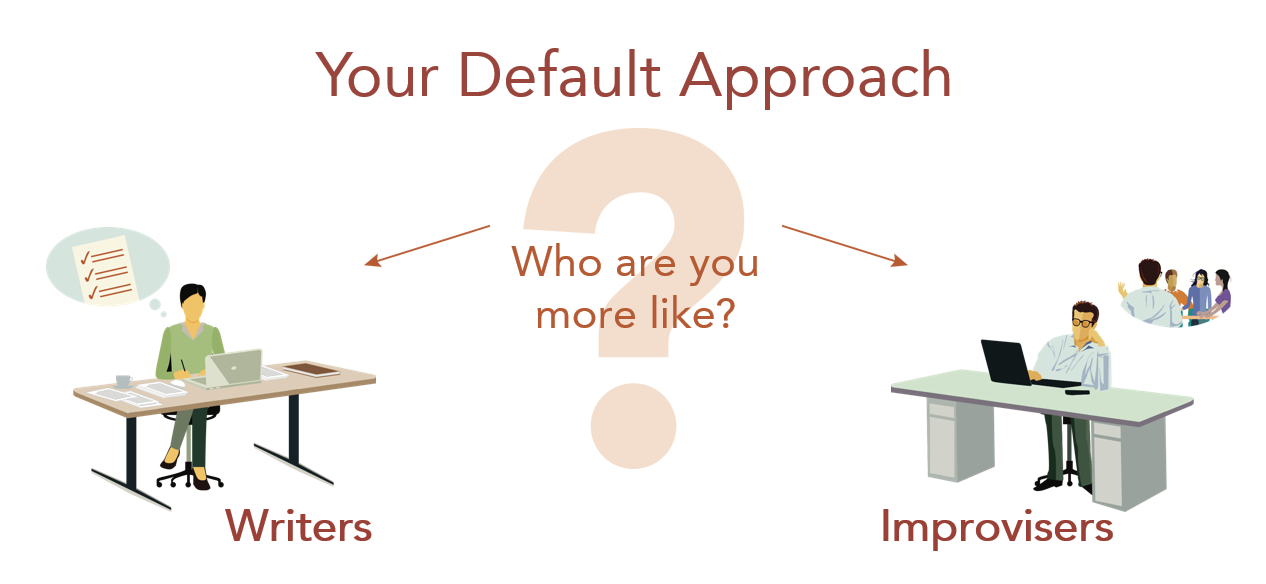
Every presenter has a set of instincts they fall back on under pressure. These aren’t conscious choices. They’re the habits your brain reaches for when stakes are high and time is short. In The Orderly Conversation® framework developed by Turpin Communication, those instincts cluster into two recognizable types: Writers and Improvisers.
Neither is better. Both have real strengths. And both have blind spots that get expensive in business settings.
The Writer
 Writers are planners. Preparation is how they manage pressure and build confidence. They feel best walking into a room with a clear structure, organized slides, and a strong sense of what they’re going to say and when.
The strength here is real. Writers tend to be organized, clear, and well-prepared. Audiences often appreciate the structure they bring.
The blind spot? Writers can become so committed to the plan that the room starts to feel like an obstacle. When a conversation moves in an unexpected direction, when a question arrives before the right slide, or a decision gets made mid-deck, the Writer can struggle to adapt. The preparation that provides confidence can create rigidity in the moment.
The Improviser
 Improvisers work differently. They’re energized by audience interaction, comfortable with ambiguity, and often excellent at reading a room. Many feel that over-rehearsing makes them stiff, so they hold back on preparation and trust their instincts instead. Improvisers are often dynamic, responsive, and engaging.
The blind spot? Without enough structure, an Improviser’s presentation can feel scattered. Key points get lost. Audiences leave unsure what they were supposed to take away. And because Improvisers don’t always prepare as thoroughly as the situation requires, the content can be harder to follow than their delivery suggests.
Why Your Default Gets in the Way
Here’s what matters most: your Default Approach doesn’t just shape how you present. It shapes what you do when something goes wrong.
Writers, when a presentation goes sideways, tend to double down on structure. They push back toward the script, try to recover the plan, and sometimes lose the room in the process.
Improvisers, when things go sideways, tend to lean harder into spontaneity: more stories, more energy, more tangents, and sometimes less clarity.
In both cases, the default intensifies under pressure. That’s what makes it a blind spot rather than just a preference.
The Goal Isn’t to Change Your Default. It’s to Adapt It.
Don’t assume that your goal is to reject what makes you a Writer or an Improviser. That approach treats your Default as a problem to fix. The goal isn’t to change what comes naturally to you. It’s to extend your range: retain what works about your natural style and build the flexibility to step outside it when the situation calls for it.
For Writers, that means developing the ability to release the plan. Not abandon it, but release it. To trust yourself enough that an unexpected question or comment doesn’t derail you.
For Improvisers, it means developing the discipline to organize before walking in. Not scripting. Organizing. A clear objective. A logical sequence. A sense of what the audience needs to decide or know. That structure becomes the backbone that keeps the conversation on track, even when it gets lively.
Adapting in the Room
Adaptation isn’t something that happens only in preparation. It happens in real time. Some signals that your default may be working against you:
- The audience seems restless, and you keep pushing forward anyway. (Writer)
- The conversation is running long, and the main point still hasn’t landed. (Improviser)
- A question arrives before you’re ready for it, and it throws you off. (Writer)
- Halfway through, you realize you’re not entirely sure if your audience is with you. (Improviser)
Noticing these signals is the first step. The second is having a go-to move.
Writers can practice pausing to invite the room: “What’s your reaction so far?” and then actually letting the audience steer for a moment. Improvisers can practice pausing to name the point: “Let me be clear about what I’m recommending here.”
Neither of these requires abandoning a natural style. Both require being slightly less committed to it.
Why Adaptability Matters for Business
When a presenter can adapt, when a Writer can respond to the room, and when an Improviser can stay on point, the results show up in the work. Decisions get made. Stakeholders stay engaged. Meetings end with clarity instead of confusion.
Business communication is too situational for any single approach to succeed every time. A presenter who can only work one way will eventually encounter a room that requires another. The Default Approach isn’t a destiny. It’s a starting point.
Find Out Where You Start
Not sure whether you’re a Writer or an Improviser? Take the Default Approach Assessment to find out and get a clearer picture of both your natural strengths and your most useful next step.