


- Greg Owen-Boger Leadership, Training
Effective communication is the foundation of two business imperatives: your leadership and your team’s performance. It also plays a role in the overall employee experience, satisfaction, and retention. Helping your employees improve their communication skills, though, can be overwhelming and discouraging for both of you.
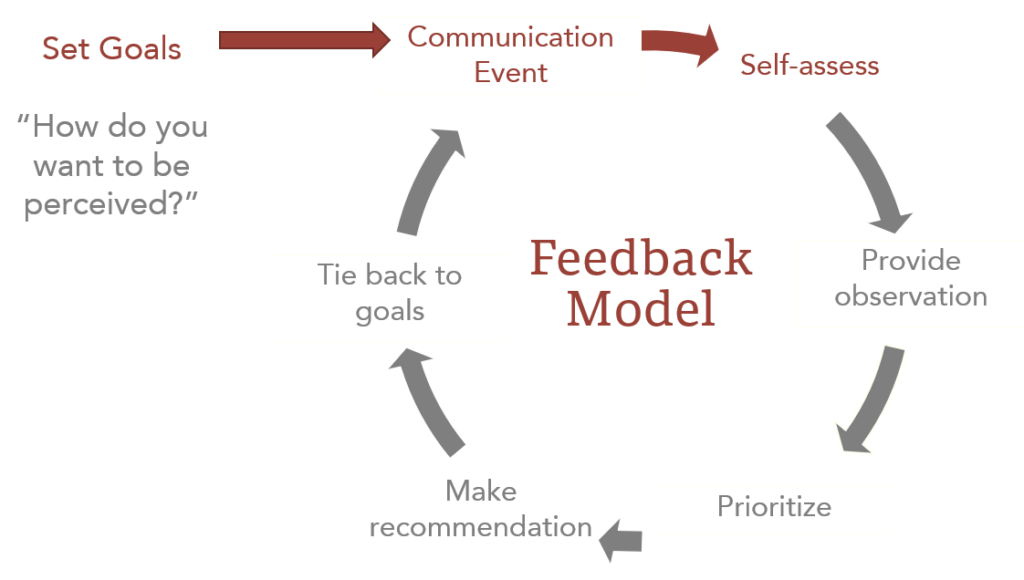
At Turpin Communication, we’ve spent decades refining an approach that helps simplify and focus the process. We call it the Communication Feedback Model. The model is designed to help you improve your employees’ self-awareness, sharpen their skills, and grow in their careers.
Here’s an illustration of the model.
Let’s walk through how you can use it with your team.
Start with Goals: “How Do You Want to Be Perceived?”
The first step in the coaching process is to have your report identify their communication goals. Your job is not to shape them into your idea of the ideal communicator. It’s to help them reach their own goals. This strengthens their buy-in for the coaching process and gives you something tangible to work with. That’s why we recommend starting every coaching conversation with this question: “How do you want to be perceived?”
You’ll likely hear responses like professional, credible, approachable, or solution-oriented. Once these goals are on the table, they become your guide for the feedback that follows. This helps you avoid one-size-fits-all recommendations and align their behavior with the image they want to project.
Keep in mind: this isn’t a one-and-done question. As your employees grow, advance, and gain self-awareness, their goals will shift—and your coaching should shift with them.
After a Communication Event: Invite Their Self-Assessment First
Once you’ve observed a communication event—a presentation, meeting, or training session—your coaching begins. But don’t start with your feedback.
Instead, ask your employee to reflect first. Ask open-ended questions like, “How did that feel?” or “What’s your take on how it went?” Then listen to their response without judgment. Your goal here is to get them talking and understand their level of self-awareness.
Often, employees are harder on themselves than you would be. Other times, they might miss the mark entirely. Either way, their reflection tells you where to start and what’s realistic in your coaching.
Share Observations, Not Assumptions
When it’s time for you to speak, be precise. Focus on what you saw and heard, and not on what you assume was going on inside the person’s mind. Use phrases like, “Here’s what I saw…” or “The thing I noticed…” Steer clear of conclusions like, “You were nervous.” Instead, stick with objective observations: “I noticed you didn’t make much eye contact with the group,” or “Your speaking pace is pretty fast.”
Offer One Actionable Recommendation — and Tie It to Their Goals
Once you’ve shared your observations, make a single, actionable recommendation. For example:
- “Let’s work on slowing your pace so people can absorb what you’re saying.”
- “Try holding eye contact to establish a connection with your audience.”
Then, when you can, tie that suggestion back to their personal goals. “You mentioned you want to be seen as credible, so slowing down will help you with that.”
By connecting the dots this way, you help them understand the why behind your feedback, making it easier for them to commit to change.
Coaching Best Practices
Normalize Growth. Everyone struggles with communication sometimes. If you create an environment where feedback is given and it’s safe to try, fail, and try again, you’ll make it easier for your team to stay open to feedback.
Avoid Scripting. It might feel helpful to tell someone exactly what to say next time. But real-world communication isn’t scripted. Your employees need to be able to think and adapt in the moment. Build their ability to do that, not just to recite words.
Focus on Engagement First. Engagement underlies all successful communication. We define engagement as being fully present and able to think on your feet. An engaged speaker is in control of their thoughts and comfortable (not nervous). Coaching, especially in the beginning, should focus on being fully engaged as a speaker and listener. We teach that two foundational behaviors make a huge difference:
- Eye Contact: Helps speakers connect with others and read facial expressions. This keeps the speaker grounded and builds trust.
- Pausing: Allows time for breathing, thinking, and formulating thoughts. For listeners, pausing helps the message land.
If you’re working with a nervous presenter, it’s especially important to start with engagement. You’ll be amazed at how many other issues resolve themselves when people are engaged.
Small Wins Matter. Here’s the most important thing to remember: progress is built on small wins. When your employee makes just one improvement, better eye contact, a clearer opening to a meeting, or a calmer pace, they begin to build momentum. Let these small wins build on each other.
You don’t have to fix everything at once. You just have to help them keep moving forward.
Final Thought
Using our Communication Feedback Model doesn’t mean adding one more thing to your already packed to-do list. It means folding communication coaching into your everyday leadership.
When your employees feel respected, supported, and heard, they become more confident and effective. And that makes your team and your business stronger.
Want to learn more about how Turpin Communication can help you develop a culture of productive coaching? Visit https://www.turpincommunication.com/
We’d be honored to support your team’s growth.