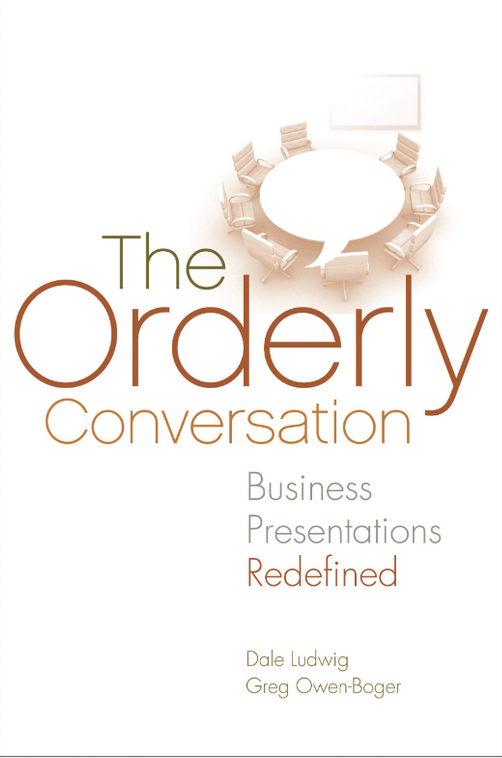



- Dale Ludwig Presentations, The Orderly Conversation
You’ve probably heard the advice. Start with an attention grabber. Rehearse until it’s smooth. Project confidence. Memorize the first sentence.
Most people have tried at least some of these tips. And most find that they don’t really help.
That’s not a failure of effort. It’s a failure of the model.
The Wrong Model
The conventional wisdom about presentations comes from the world of public speaking, which focuses on speeches. Keynotes. Podiums. Large audiences. One-way delivery. These are all performances, and that context shaped decades of presentation training, books, and coaching. Most of it still gets recycled today.
But that’s not the world business presenters actually work in.
Consider the settings you present in: a conference room, a video call, an audience of five people who know the subject and already have opinions about it. In this environment, the stakes are real. A decision gets made, a project moves forward, or it doesn’t. That’s not theater. It never was.
Importing the speechmaking model into that environment creates a specific problem. It turns a presenter into a performer, and performances are one-way by design.
What Happens When Performance Takes Over
The performance mindset turns attention inward.
Instead of reading the room, a presenter locked in performance mode is managing the script: what comes next, what the slides say, whether the pacing feels right. Meanwhile, the CFO shifts in her chair. Two people exchange a glance. Someone has a question they’re not sure how to raise. None of it registers.
When presentations fail to connect, this is almost always the reason. Not because the presenter was boring or underprepared, but because they were talking at people rather than with them.
The result is familiar. Audiences feel like spectators rather than participants. Decisions get deferred. Buy-in doesn’t happen. The presenter walks out wondering what went wrong.
A Better Model: The Orderly Conversation®
At Turpin Communication, we define business presentations as Orderly Conversations. The definition is simple, but the implications run deep.
Orderly means a successful presentation is well-prepared and clearly structured. There is a clear goal, organized information, and a sense of what your audience needs to know and in what order.
Conversation means a successful presenter is engaged and responsive. The presenter listens as much as they talk, adjusts as the discussion unfolds, and treats questions and pushback not as interruptions but as the conversation doing exactly what it should.
Both elements need to be present, and when there’s too much of one of them, the presentation tends to go wrong in a predictable way. Too much “orderly” and it becomes a performance. Too much “conversation” and it loses its purpose.
The Productive Tension
Good preparation, in The Orderly Conversation model, isn’t about memorizing what to say. It’s about knowing how to respond to what actually happens in the room. The goal isn’t to follow a script but to work from a framework flexible enough to bend without breaking.
Preparation improves clarity. Conversation builds connection.
When both are working, something shifts in the room. Instead of passively receiving information, people start participating. Their questions are pointed and relevant. The discussion goes somewhere useful. That’s when real progress is made.
The insight worth holding onto: preparation and conversation aren’t competing priorities. Solid preparation is what makes genuine results-oriented conversation possible.
Putting This into Practice
There’s no single formula, because every presentation is different. But a few behaviors will help:
Prepare for the goal, not the performance. Before thinking about what you’ll say, get clear on what your audience needs to understand, agree to, or decide. Let that shape the preparation.
Make room for conversation. Pause and appear open. Plan moments to invite response rather than saving questions for the end. The most important issues often surface only when there’s room for them.
Stay curious. A question that seems to derail the agenda might be pointing toward something that matters more than you originally thought. The ability to recognize that and respond to it is what separates a useful conversation from a forgettable one.
Being prepared enough to be flexible is the goal. That’s very different from polishing a performance.
The Bottom Line
The speech mindset feels safe because it offers control: over the words, the slides, the pacing. But that kind of control focuses attention solely on what’s visible and predictable. When that happens, the one thing that actually matters goes largely unmanaged: whether the people in the room are genuinely engaged and following along.
Business presentations exist to move business forward. That requires real participation: questions, honest pushback, a conversation rather than a performance. Once that shift takes hold, everything else about how to prepare and what to do in the room starts to make more sense.
Contact us to learn how we can help you and your team apply The Orderly Conversation concept to your presentations.